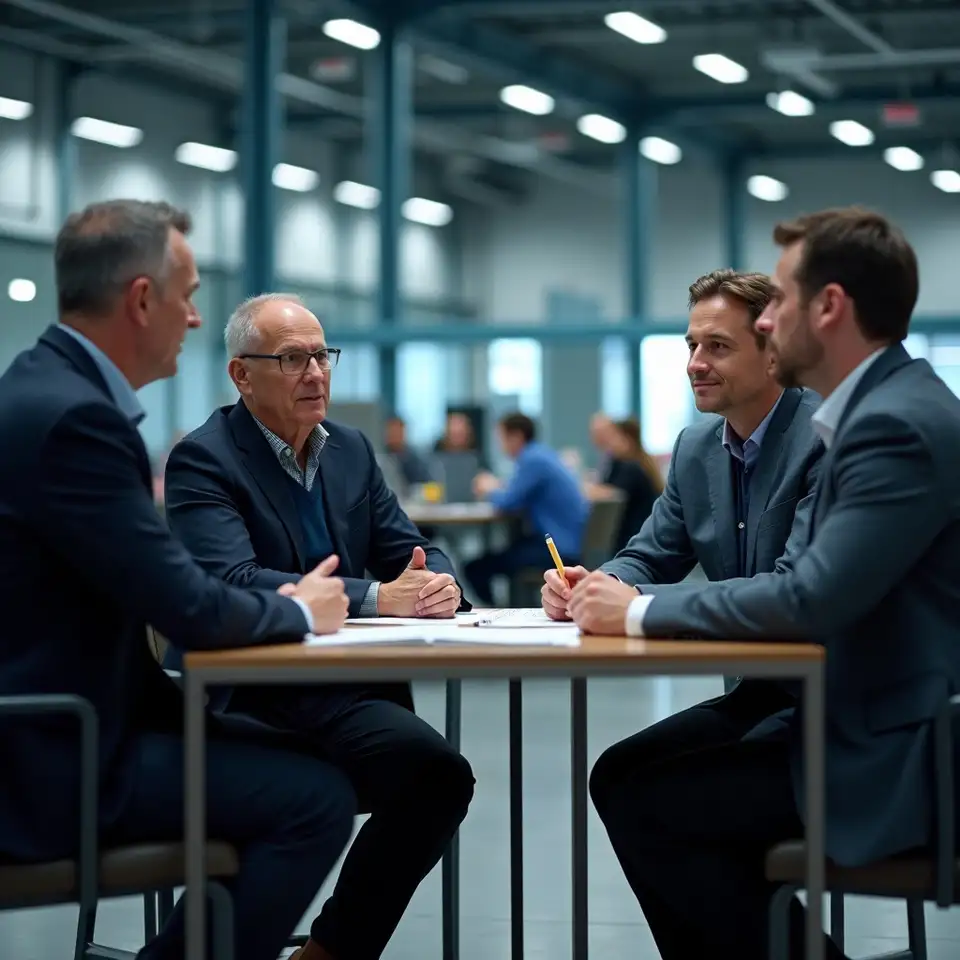
industrial finance team meeting with operations leaders

Next steps

Calm spreadsheets can hide turbulent plants; bringing both views together starts with a candid conversation about how your facility really operates.

Financial models often look calm precisely because they ignore the noise of daily operations. We invite you to bring that noise into the conversation. Share where breakdowns tend to cluster, how supplier behaviour has shifted, and which metrics your board watches most closely. With that context, we can help you frame decisions that respect both the volatility of industrial life and the structure of financial obligations. Our aim is not to simplify your world, but to make its complexity easier to navigate with open, well documented choices.
Learn more

Plant realities

Industrial facilities rarely fail because a single number was slightly off; they struggle when a series of small, unexamined assumptions compound over time. A maintenance interval extended here, a supplier term shortened there, a capacity forecast that quietly assumes no disruption. Each choice seems minor in isolation, yet together they can reshape the financial profile of an entire site. At Nolexivera, we spend time with the details that are easy to skip. We ask how long it truly takes to bring a line back after a stoppage, which inputs have few substitutes, and how often key customers revisit their own sourcing strategies. These questions do not produce simple answers, but they help narrow the gap between what a model assumes and what the plant can actually deliver. Our work is grounded in Canadian industrial conditions, where regulatory expectations, regional infrastructure, and climate all influence financial planning. We consider how seasonal patterns, labour availability, and transportation constraints may interact with financing terms and covenants. Instead of offering pre packed solutions, we help you examine how each option behaves under strain. We encourage clients to treat our input as one piece of a broader decision process. Results may vary, and independent professional advice remains essential. Past performance does not guarantee future results, and no analysis can remove uncertainty. What we can offer is a disciplined approach, clear communication, and a written record of the reasoning behind each recommendation you choose to adopt or decline.

Why industrial finance context matters before you sign

A structured way to approach complex industrial finance questions

An idle production line can be more expensive than a poor rate on financing, yet many discussions treat them separately. At Nolexivera, we connect operational constraints with financial structures so your team can see the whole picture. We listen first, map how value flows through your facility, then highlight where financial decisions intersect with bottlenecks, downtime risk, and supplier dependence.
Our internal method, the Three Lens Review, examines each decision through operational, financial, and regulatory lenses. This helps surface trade offs that might otherwise remain hidden in footnotes or side conversations. The outcome is not a promise of performance, but a clearer view of what you are accepting when you move ahead. Results may vary, and we encourage independent professional advice alongside our perspective.

Grounded in real plant conditions, from shift patterns to maintenance backlogs.

Balanced view of financial options, trade offs, and long term obligations.

Documented reasoning so leadership can revisit key assumptions over time.

finance and operations specialists reviewing industrial dashboards in control room

Focused on decisions, not products

Clarity before commitment

Industrial finance insight for complex Canadian facilities

industrial finance specialists reviewing plant performance data together

Industrial finance context for capital heavy Canadian operations

Nolexivera focuses on industrial finance questions where a small change in assumptions can reshape an entire facility’s future. We translate complex financial language into clear, decision ready insights tailored to Canadian industrial operators.

Many industrial teams carry deep technical knowledge yet feel exposed when conversations shift toward capital structures, financing conditions, and scenario analysis. We help bridge that divide. Our work starts with understanding how your production system behaves under stress, not just under ideal loads. From there, we examine how financing choices, covenants, and timelines might amplify or soften that behaviour. We emphasise traceable reasoning, conservative assumptions, and documentation that can stand up to internal review or external scrutiny.

Industrial finance decisions rarely fail because a formula was wrong; they fail because context was ignored. We look at your suppliers, workforce constraints, maintenance strategy, and regional market conditions before we discuss funding structures or long term commitments. Our internal approach, the Plant Reality Review, follows three steps: clarify the operational baseline, map the financial exposure points, then explore scenarios that align with your risk tolerance and strategic aims. We do not promise outcomes. Instead, we provide structured thinking, clear language, and a record of assumptions so leadership teams can move forward with open eyes and informed debate.

Industrial finance looks abstract on paper yet feels concrete when a machine stands idle. At Nolexivera, we focus on that gap between spreadsheet logic and plant reality. We work with manufacturers, processors, and logistics operators across Canada who need clearer thinking around capital intensive decisions, regulatory expectations, and long asset cycles. Instead of generic theories, we look at line layouts, maintenance patterns, and supplier terms to understand how money actually moves through your operations. Our role is not to sell products, but to frame the financial questions that matter before you commit to large, often irreversible choices. By pairing industrial context with disciplined financial analysis, we help you see how each decision touches capacity, resilience, and long term obligations.

Benefits of a grounded industrial finance perspective

A new machine can change a balance sheet faster than a market swing; our work starts with how industrial assets behave long before spreadsheets are finalised. We help Canadian operators frame decisions so financial and operational realities stay connected.

Joined up operational and financial view

Industrial decisions often span many years, while financial discussions sometimes focus on the next quarter. We help teams trace how today’s commitments might shape tomorrow’s capacity, maintenance, and resilience. By mapping cause and effect across departments, we make it easier to see how a change in demand, regulation, or supplier stability could affect cash needs and covenant headroom. The goal is not prediction, but preparedness based on realistic, clearly stated assumptions.

Map cause and effect

Connect plant and finance

Structured view of exposure and resilience

Risk in industrial finance rarely comes from a single source. It emerges when several small pressures line up at once. We work with you to identify where exposure could build up, from contract terms and maintenance deferrals to concentration in a single customer or region. We then explore scenarios that stress these points in practical ways. Past performance does not guarantee future results, so we treat scenario work as a way to rehearse responses, not as a promise that any one path will occur.

Highlight exposure

Explore scenarios

How Nolexivera approaches industrial finance questions

Financial pressure in industrial settings often emerges slowly, then all at once; our approach is to examine how small operational shifts can accumulate long before they appear in headline metrics or covenant tests.

Start from physical operations first

Financial discussions often start with targets, yet industrial systems start with constraints. Our first focus is the physical reality of your facility: equipment mix, layout, maintenance practices, labour skills, and supplier concentration. By mapping these elements, we build a picture of how your plant behaves under normal and stressed conditions. Only then do we connect this picture to financial options, timelines, and obligations, keeping assumptions transparent and open to challenge.

Scenario chains instead of single forecasts

Many teams are asked to decide quickly without seeing how a proposal behaves under different conditions. We apply our internal Scenario Chain Method, which traces how shifts in demand, pricing, downtime, or regulation might cascade through your facility and finances. The aim is not to predict a single outcome, but to reveal which variables matter most. This makes it easier to discuss trade offs with stakeholders and to document why certain paths were chosen or set aside.

Shared language across disciplines

Complex industrial projects can lose momentum when finance, engineering, and operations speak past each other. We translate technical details into clear financial implications, and financial terms into operational consequences. Meetings focus on decisions, not on decoding jargon. Each step of our work produces concise summaries that leadership can review without needing to reconstruct every calculation, while still having access to the underlying reasoning when needed.

Documentation ready for scrutiny

Regulatory expectations and lender requirements shape what is possible long before contracts are signed. We help you prepare documentation, narratives, and supporting analysis that reflect Canadian regulatory norms and prudent practice. This includes clarifying risk factors, outlining mitigation steps, and noting where uncertainties remain. We avoid promises or projections that overstate certainty, recognising that past performance does not guarantee future results.

Industrial finance in practice across facilities

Your cookie choices

We use cookies and similar tools to keep nolexivera.sbs secure, understand how our industrial finance content is used, and remember certain preferences. You can manage cookies in your browser or review details in our policies before choosing how to proceed.